Saturday, May 1, 2021

Thursday, August 10, 2017
Hartford Artisans Weaving Center
I am taking intermediate level hand weaving lessons through the Hartford Artisans Weaving Center in West Hartford. They have a satellite classroom in Manchester, where I attend class. My goal is to expand my knowledge of weave structures, so I started with an exploration of huck weaving on 4 harnesses, and created a light blue table runner. From there, I worked on 8 harnesses to create a striped huck lace scarf in 8/2 Tencel. The color way is rust, brick, olive and terra cotta, in a narrow stripe pattern that coincides with the weave pattern. The result is pretty close to what I envisioned! I am very pleased with it, and I have learned to warp from back to front with these projects. I learned to warp front to back and have done my warping this way all these years, so it is nice to have a new technique for that under my belt. I am currently planning warps for 3 more projects to work on at home, and hope to get the warps put on the looms before I go back to work in a couple of weeks, so,that I will have them ready to work on as time allows during the school year, on weekends and vacation days.


Saturday, November 26, 2016
November Art Batt for Handspinning
A second cup of tea and some early morning studio time yielded this art batt for spinning. I worked up some color ways using my Color Aid papers. Looking outdoors this November I matched up some of the colors I saw in the landscape, and pulled those swatches from the Color Aid deck. Then I tried out some of the colors with my paints, settling on those I wanted in my art batt. In the studio, I used hand dyed Border Leicester locks, fawn colored kid mohair, and silver Romney to create the batt on the Louet Classic drum carder. I love the soft color, which reminds me of the gray/beige of tree trunks, and those deep purple berries I see on my walks this time of year, hanging amidst the bare brown twigs of the bushes. Can't wait to spin it up!
Wednesday, October 12, 2016
The Shawl from Hell......
This is my first lace shawl. I have been humbled by this experience. As a knitter, I can say that I have been forged by the fires of this experience. I can now consider myself an "experienced knitter"---not an expert, mind you, that will come later! I naively thought, before taking this on, that if I could produce a lace shawl, I will have reached a goal in my development as a fiber artist that I had set for myself. Always try something you have not tackled, and you will keep on learning! I did, needless to say. I began this shawl 5 years ago. Yes, you heard that right--5 YEARS! I started it with a lovely lace weight dusty rose yarn. I had to rip the shawl back so many times, because of mistakes I made and did not detect until rows of knitting later, that the yarn became ruined. That was heartbreaking. I began questioning my mental capacity, and my bruised ego gave up on it so many times......I shoved the mess into my knitting bag for months at a time, out of pure disgust. Began again with a sock weight yarn that was easier to work with, and forged ahead, with renewed enthusiasm! More ripping back, consulted the Internet, books, any and all manner of research.....gave up a few more times, etc., my battered ego in the ditch. With a half done shawl, and some experience about what NOT to do, I learned to "read" my knitting, check every single row for accuracy before beginning the next row, learned how to use a "life line" thread, and swallowed another pill of determination! Needless to say, I am feeling accomplished and very happy and relieved to have this shawl done and on the blocking mats! I can't wait to start another lace project.
Saturday, October 8, 2016
Hand Dyeing Border Leicester Fleece
These photos include color ways in blues and orange, grays and purples, and greens and rose, although the photos don't do them justice! They are soft and lustrous and a joy to spin. I dyed these using a low water immersion technique, on my stovetop, and Jaquard Acid Dyes. A very non-scientific approach, and rather freeing, I might add, since I did not follow my customary weighing and measuring of the dyestuffs. I simply prewet the wool adding a bit of soap to break the surface tension of the water and allow the dye to attach more easily to the fiber. Then, once arranged in the pan with water to barely cover the locks, I randomly sprinkled the dye on top, adding vinegar to help the dye strike, until the water cleared. Can't wait to spin these! I will be looking for Wensleydale fleece and Teeswater as well, next weekend, at the Rhinebeck Sheep and Wool Festival.....those breeds are coveted by spinners, and are softer (finer micron counts) than the Border Leicester! So many possibilities......!


Lock Spinning
This Border Leicester fleece, purchased at the Ct. Sheep and Wool Growers show in Tolland this past spring, has washed up beautifully, and takes dye on with richness and luster. I hand dyed cleaned locks with deep reds, smoky grays, and some purple, and then used the lock spinning method to create this soft lustrous art yarn singles. After washing to set the twist, it will most likely become part of a tapestry project I have in mind....I am spending the long Columbus Day weekend in my studio, as time allows, in between other commitments, and I feel like a kid in a candy store! I will post more photos shortly, of the rest of the dyed Border Leicester.....

Wednesday, May 18, 2016
Lace Scarf
This lace scarf is on the needles, and uses 2 skeins of Malabrigo Baby Silkpaca in the Frank Ochre color way. It is soft and featherweight, a dream to work with. The pattern is the "Airy Lace Scarf", from the book "Scarf Style 2". Also on the needles is the Pioneer Cuff, a kit by Laura Nelkin, in Anzula Cloud, which is a silk and cashmere blend in the charcoal color way. This is a beaded knitting project. Both are small, and great for summer travel, since they pack easily and don't take up much space. 

CVM Romeldale and Cheviot-Romney Lamb Fleece!
Two fabulous finds this spring at the Connecticut Wool Growers Festival--a beautiful washed Romney-Cheviot lamb, and a CVM Romeldale fleece in a silver gray color way. Both are very soft. In addition, I found a large Border Leicester fleece, perfect for core spinning or lock spinning, with those lustrous curls. Can't wait to start experimenting with these! The dye pots will be full this summer.....

Tweeds!
These tweed batts and the resulting hand spun yarns were so much fun to create. I started with a tweed mixture of silk Nepal that I had dyed to a mustard gold, and some in black, others were left natural cream. I added them as a sandwich, between layers of naturally colored wool fiber, cream, gray and deep brown, on the carding machine, to create the tweed batts. Then they were spun up to a light worsted weight yarn. I discovered that the yarn was too dense for a shawl that I had envisioned, even though I prepped and spun for a woolen yarn. The fiber is too course. It would, however, be great as a a sweater, or a tote bag or some item that does not need to be next to the skin soft and light as a feather. This project requires a finer fiber, perhaps BFL, or a merino wool. A fine cheviot would work, too. It is so important to sample, sample, sample. Next steps--look through the fiber stash to find something softer!


Weaving Samples
I had many bobbins full of yarn, and this Mountain Loom Company table loom that belonged to my mother in law years ago. She was a also a handweaver, knitter and hand spinner. I decided to put it to use making samples up from Marguerite Davison's work "A Handweavers Pattern Book", with a pattern called "Jewell". It is a Rosepath pattern, with a number of variations. I'm using up yarn leftovers in assorted colors. This is so much fun, and not a huge time or money commitment! I've been spending the winter months playing with art quilting and surface design on textiles, which requires a lot of materials, and makes a mess (in other words, you really need a big space to work in, while creating! Not a bad thing, just a lot of prep/clean up...)---I love getting back to weaving, it is simple and repetitive (great when you don't have a lot of time, and once the brainwork is done, and the loom is warped, you can pick it up and work on it here and there, as time allows in the evening or on busy weekends at home. We are currently setting up this spring to continue painting our house, and that work will continue into the summer. Since I teach, I have the summers off, so I will hopefully have a sample chosen from this pattern set, that I will use to warp up my new Schacht Baby Wolf loom for some summer weaving! That is, in between house painting sessions!


Thursday, December 31, 2015
Art Before Breakfast
Danny Gregory's book is a fun read, with drawings, to kickstart the drawing process when you think you don't have time. With daily suggestions for sketching over coffee, and a myriad of other ways to fit sketching into your busy work a day schedule, it helps get your creativity going. Sketch booking is a way for me to document ideas, and save them for future reference and to spark finished artworks, whether drawings, paintings, art quilts or mixed media projects.


Sketching "Grab and Go" Tote
This is a perfect solution to my need to have art materials at the ready, whenever I want to draw or paint. This is my sketching tote. Everything is in here that I might need when working on location, or even here at home, out in the yard or indoors. There are no excuses now! It includes a mixed media sketchbook, a smaller sketchbook with 60 pound drawing paper, and a small canvas covered one with lightweight scratch paper. In addition to that, there is a small journal with lined paper, and a small pad of watercolor postcard sized paper. There is a roll of artists low tack tape, to mask off for borders, a box of water soluble sketching pencils in various colors and neutral tones (Stabilo Aquarellable, and Derwent Drawing Pencils and Wash Pencils), and a watercolor paintbox with a brush. Also included are 3 Tombow brush pens, felt tipped and water soluble, and several Pigma Micron waterproof ink pens in different sizes. Also, a Papermate Flair pen, and a regular ball point pen, 2 water rush pens,a mechanical pencil and stick eraser with refills. A calligraphy pen and a set of Tombow Professional drawing pencils rounds out the contents. Lastly, a pair of small scissors, a 6" ruler and a pencil sharpener. These items will give any serious artist plenty of options while on location or back in the studio. There is nothing worse than giving up when inspiration strikes, because it will take too long to gather the materials you need! I hope to get many years of service out of this tote bag, and lots of sketchbooks filled with drawings and paintings!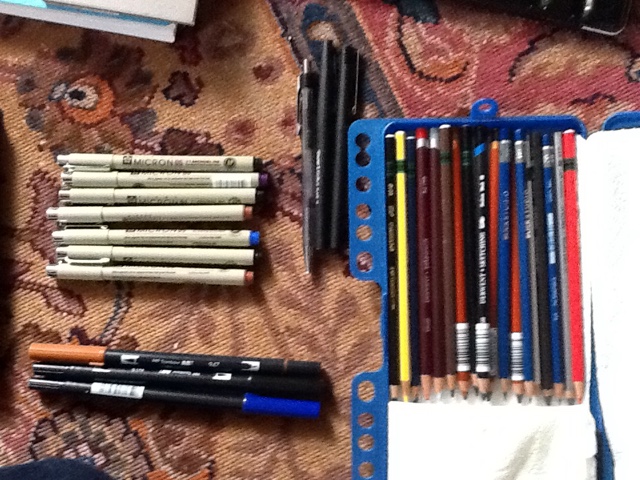


Happy 2016!
This sewing folder was made to use in my new "Hexie kit"! I am exploring hexagon quilting, and needed something that was extremely small and portable, to work on when traveling. This folder, and the Hexie supplies fit neatly into a small bag or box, and store efficiently in my duffle, backpack or tote bag, when out and about, or in our camper. And, it is always fun to find new fabric treasures while on the road, to add to the Hexie box. 

 Began weaving this scarf on my 12" Ashford Rigid Heddle loom. Yarns, in sock weight, found in my stash, are in 2 color ways. The first, a soft baby blue, and the second, creating the windowpane plaid, in a self striping variegated. This is the resulting pattern. I like the way the variegated yarn breaks up the regularity of the check pattern. It appears more pronounced in the darker areas of the yarn, and less noticeable in the lighter blue and gray areas, that almost match the color of the solid yarn. It is set at 12-1/2 ends per inch, perfect for the sock weight yarn.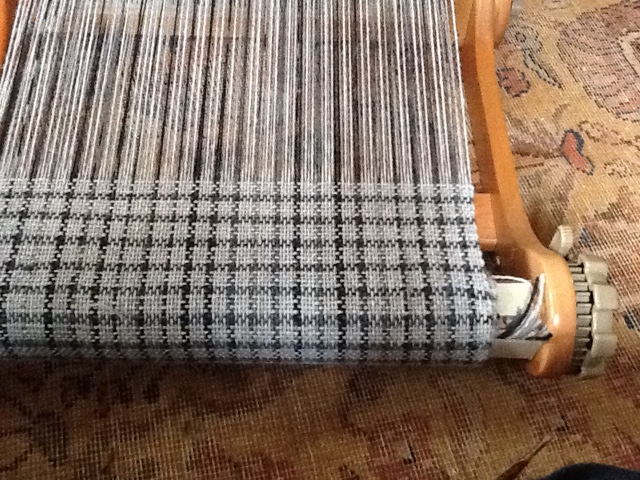
Saturday, April 11, 2015
Ashford 12" Knitter's Loom Review
I purchased this little rigid heddle loom last year with the thought that I would use it primarily for sampling before putting any project onto a larger loom. It is small and easy to transport from room to room, and that is nice when I want to sit down and work in my living room rather than in the studio, or perhaps out doors. The entire loom and stand break down easily, and fit into this tote bag! Another plus. After having woven on it a number of times, I have noticed that the warp beam in the back can ride up a bit, and require tightening of the knobs where the loom folds up. A little fiddly, but overall, a great little loom for the price, and the portability and small size far outweigh the minor engineering issues. I ordered 2 reeds so that I could use 2 at a time, thereby allowing me more flexibility for warps with closer setts. I ordered the reeds in a variety of sizes, for sampling purposes, as well as the double heddle reed support blocks to accommodate them. We have since acquired a camper, and I am pleased to say, this little loom is perfect for,camper travel. Small, lightweight and portable in its tote bag, it is perfect  to grab and go when we are ready to take off for any road trip.
Sakiori
The blues are most undoubtedly from indigo dyed cottons, used in the original clothing. When they became ragged and worn out, they were cut up into thin strips and rewoven into new cloth which was then made into new garments. They are beautifully textured, and subtle in their color gradations. 


Tuesday, July 29, 2014
Current Sewing Projects
Tumbling blocks quilt pattern, in a vintage color way called "Betty Dear", although I don't remember the name of the fabric company that puts it out. I purchased the fabric as a jelly roll, but it did not have a good range of values, so I had to go out and purchase some additional lights and darks to round out the selection. This will become a small bag.
 The next photo shows a beautiful complementary color scheme of blues and yellows, in a reproduction Civil War cottons designed by Jo Morton of Andover Fabrics. I cannot wait to try some civilwar era patchwork quilting projects with this.
The next photo shows a beautiful complementary color scheme of blues and yellows, in a reproduction Civil War cottons designed by Jo Morton of Andover Fabrics. I cannot wait to try some civilwar era patchwork quilting projects with this. July 2014 Handspinning Samples
LThese handspun yarns were created with Ashland Bay Corriedale Top and Cheviot Top. Both tops were blended on my Ashford blending board, with various blends, ranging from dyed wool top, dyed mohair, and Sari silk ribbons that had been cut into flecks and added directly onto the blending board. Some samples were core spun using fine sewing thread in coordinating colors, and/or blended with bits of dyed silk noil. Some plied, some singles.....this was so much fun, and a serendipitous creative venture! It was a spontaneous mixing of colors and textures that yielded terrific results! I will probably use these yarns for Saori weaving, or maybe some fine knitting--the yarn is well suited to scarves or shawlettes. I am thinking of a linen stitch, perhaps, that would show off all the color gradations, but there are many other options I could try!


Thursday, June 26, 2014
Romney Lamb Fleece 2!
Here is the lambs fleece, after scouring. An unwashed lock is on the far left for comparison. The washed locks are in the middle, and the flicked (combed) locks are on the right. I will be spinning these worsted style, to get good stitch definition, probably something in a sport weight size...I will spin up some samples, and see what ideas they suggest. As spinners we are so lucky because we can design the yarns we want for the intended end use. Sometimes you see a fleece, and immediately know what you would like to create with it, based on its characteristics. Other times, you buy a fleec just because, and you start experimenting with its possibilities, before coming up with an idea. At this point in the creative process, now that I have a sense of what the washed fiber feels like, looks like, and how it behaves, I am thinking about scarves and hats....it has great springiness, bounce and elasticity, due to the crimp in the locks, and it is next to the skin soft, perfect for scarf wearing. A worsted prep will give me great stitch definition, perfect for color work, or knit and purl patterning, which is probably what I would like to do with my knitting. The characteristics of the fleece suggest certain paths to follow in the planning of the end product. I love all the possibilities at my fingertips!
Romney Lamb Fleece...(finally!)
This fleece was purchased a year and a half ago, at the New England Fiber Festival in Springfield, Mass. And I have finally worked my way through a long list of fleeces awaiting scouring, to finish up with this lovely Romney Lamb fleece. It has beautiful, consistent crimping, the locks are very well maintained, and the fleece is a fairly consistent length throughout. I decided to sort it by whiteness/brightness and fineness. Even though it is fairly consistent throughout, I came up with 3 grades as you can see in the photo. The finest, cleanest wool is on the far right, the courser and dirtier (more yellow) is on the far left. The bag in the middle is the fullest, and although a bit more yellow than the prime wool, it is still very soft and fine. My guess is that it will wash up fine, but it may be a bit more on the creamy side, whereas the prime wool will be a bit more on the white side. This fleece is a very clean one to start with, no VM, and no dirt. My guess is that is was a covered fleece, although it did not say so on the label. The weight is 3.5 pounds, and I paid $30 for it. A steal, if you ask me! The white tulle in the photo is for scouring. I will wash this fleece and maintain the lock structure by layering the fleece pieces in between layers of tulle netting, and tying the bundle with string to keep the butt ends all lined up. I will be spinning worsted style, so this is the prep routing I will follow. You can see the washed fleece in the next post.
Sunday, May 11, 2014
More from NH Sheep and Wool!
Here are photos of the things I found at the Festival in NH...from Ellen's Half Pint Farm in Norwich, VT, a beaded lace shawl knit and pattern in a soft springtime color way....pinks, greens, lavenders, grays and yellows, with dark pink seed beads, and a very interesting book on knitting beaded jewelry and other small items. Can't wait to get this one started.
 The next photo is a beautiful dyed BFL 4 oz. hank of wool top for spinning from "Friends in Fiber" in free, eggplant, turquoise and mustard....
 AAnd some dyed BFL roving 4oz. Each, for spinning from Painted Knoll Farm in New Hampton, NH. This is very silky feeling, and would make beautiful shawlette a in a lace pattern. The colors are very rich.
The next photo is a beautiful dyed BFL 4 oz. hank of wool top for spinning from "Friends in Fiber" in free, eggplant, turquoise and mustard....AAnd some dyed BFL roving 4oz. Each, for spinning from Painted Knoll Farm in New Hampton, NH. This is very silky feeling, and would make beautiful shawlette a in a lace pattern. The colors are very rich.
Subscribe to:
Posts (Atom)