After a fun day fabric shop hopping with my sister and my mother, I became inspired to dig out my punch needle supplies and create a primitive sheep, in progress here. We visited a shop in Boxboro, Mass. Called "The Quilted Crow". It is probably the nicest shop of its type I have been to! There are lots and lots of beautiful cotton reproduction quilting fabrics to choose from, and dyed wool fabrics for the penny rug and wool appliqué lovers out there, as well as rug hookers, and beautiful samples of primitive punch needle work. This shop has kits and supplies for all of these colonial/primitive folk crafts. Once I finish this sheep, I will be working on a punch needle pattern that I purchased at The Quilted Crow, called "Tree Farm" (PN249, by Brenda Gervais at "With Thy Needle and Thread"). It is shown below. This pattern calls for Valdani thread, and I am substituting DMC cotton. There is no chart online for the color substitutions, so I am using my best judgement and looking at the cover photo to approximate the colors. I may use some walnut crystals to overdue it when I finish, if I feel the colors need to be toned at all. We shall see! I also purchased a wool appliqué kit, for a candle mat. Lots of things to keep busy over the winter months!
Wednesday, January 1, 2014


Tuesday, December 31, 2013
Lace Knitting Lessons
I am an art teacher. It is my chosen profession, and my main source of income. In addition, it is deeply satisfying on a number of levels to me personally, as an artist, and a human being. I love the energy, enthusiasm and joy the children bring to my classroom, and thereby, my life. My students drive me forward, as a teacher and an artist, to explore the what-ifs, and stay hungry for new knowledge. Did I mention that it is exhausting? Or that there are those days that things don't always go as planned? The days are, without a doubt, filled to the brim with unexpected turns, and lots of great art making. I wistfully think about what my life would be like as a full time fiber artist/shepherd , happily spending my days spinning, weaving, art quilting, tending the flock, and generally producing as many artworks as my heart desires. I, instead, plan and execute what I can during my non-teaching hours, after school, and on weekends and vacation time. I awaken at 4:30 a.m., have my ritual cup of jasmine jade tea, pore over my reading materials, which consist of several knitting, spinning and weaving magazines, art quilting and historic needlework publications. My most energetic hours are these, in the wee hours of the morning. After work, I prep dinner, do a little working out, and settle in for some light knitting or spinning, generally. Weekends and vacation time are for the bigger project set-ups, re-grouping and reflective activity that keep me focused. This photo is the most recent knitting project I have undertaken. It is a lace shawl. My first. What a challenge. I have discovered much about myself in this process. I have ripped back on many occasions, made plenty of mistakes, and gotten irritated to the point of putting the shawl away for weeks at a time so that I would not have to look at it, or deal with it. I have asked myself on numerous occasions, whether I really like lace knitting or not. I have finally discovered, half way through this ambitious project, that I need to "read" my knitting. If I can do that, I will make fewer mistakes and feel more enjoyment from the process, which is the reason we do this thing called knitting anyway, right? I also know that I cannot do this kind of knitting with any distractions. I need to be able to be totally enveloped in the shawl, thinking, living, breathing the shawl. Lots of counting, checking the rows that came before to use as a point of reference for my new row accuracy. Whew! I cannot wait to be finished, sort of the way a mountain climber feels once he or she reaches the summit! Worth all that hard work. And maybe the next shawl will not be as challenging, since I will have all of this experience behind me!

Monday, August 19, 2013
Dyed Leicester Longwool Fleece
The colors below were dyed on Leicester Longwool that I purchased in the grease at the New Hampshire Sheep and Wool Festival this spring. I scoured the fleece, then dried it on the screens. I used Greener Shades dyes, which come in a kit. I purchased mine from Knit Picks. It is about $35 or so, and the kit dyes up to 13 pounds of fiber. The directions leave a lot to be desired. I would not call the set of dyes a kit , at all, because of the lack of clear directions, but, nevertheless, the dyes are excellent, and I used Deb Menz's "Dyeing in the Kitchen" DVD to get me started with how to proceed with mixing the dyes up and using them. The colors are clear and strong, and very mix able. I obtained some clear, beautiful true colors when I mixed them together, and when toning them down with black, for deeper shades. I found it best to purchase a large plastic tub to put all of my dye supplies and equipment in. This way, when I want to have a dye day, all I have to do is pull out the tub, and everything I need is at my fingertips.


You will need:
A digital scale that can weigh In grams and pounds
Plastic table cover
Buckets
Measuring spoons
Smooth sided clear plastic cups
Colanders
Plastic knives or stirring implements of some kind
Sponges and rags for wiping spills
Rubber gloves
A thermometer
Pots with lids
9x13 roasting pan--good for casserole dyeing
Saran Wrap
Synthrapol
Stencil brushes (large work best)
Plastic syringes without the needle (you can get these at farm supply stores) that measure in milliliters or cc's (these are both the same)
Canning jar steamer kettle with wire rack insert
Dyes stock containers (I use the plastic disposables with good fitting lids, that hold 3-4 cups of liquid)
These items will get you started. You may wish to add others as you go. I store my tub in the basement, where it is cool, and I keep the extra dyestuff there as well, rather than in the attic. I keep a couple of old house screens in my basement to dry the fibers on out of doors on a sunny day. Most of my dyeing days are in the summer and fall, when the weather is nice, and I can make a mess outdoors and not have to worry about it! Then, I have beautiful dyed fiber to work with all winter long at my spinning wheel. The photos below show some of the rich colors I got on this fleece. I had to be very careful when dyeing these locks, felting can be an issue when working with them and the hot dye liquor! Avoid agitation, and you should be fine. I can't wait to card and spin some of these locks into yarns! I can envision some interesting art yarns with these....
Sunday, August 11, 2013
August Dye Day!
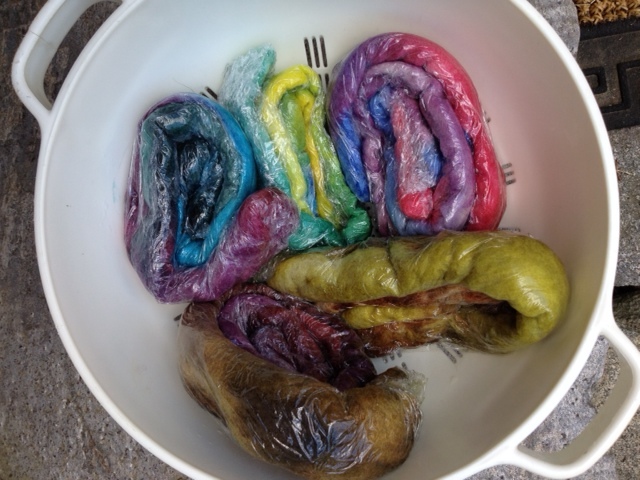
A sunny, dry day, perfect for outdoor dyeing. Today was so much fun, and I now have bags full of wonderful color ways to experiment spinning with! I used about 2/3 pound of 100 percent wool roving, soaked in Synthrapol (about a 1/4 cup, in 3 gallons of water). Using a 1% solution of Greener Shades dyes, I toned down the intense colors in most of these samples with the addition of black dye. I prepared 1% solutions, but since I was handpainting the wool, I ended up using more than what I had prepared, and had to go back in the kitchen to prepare more dye to finish all 350 grams (roughly 2/3 pound fiber). The one labelled "Parakeet" had no black in its colors. These are the pure hues resulting from the dye stock, with approximately a two to one ratio of dye stock to fiber weight. This was a purely experimental day, one meant for me to get comfortable with the dyes, and the resulting colors. Next, I would like to play with color schemes, tints, shades and more color theory! I notice that I have to be careful not to felt the fiber as I apply the dye with the stencil brushes. The fibers were painted on top of Saran Wrap, sealed up and rolled, then put in a steam bath over the stove, using a canning kettle with a wire insert to lay the rolls on as they steam. This took about a half hour to complete. The rolls were left to cool down, then unwrapped, rinsed gently with water, and hung to dry, after fluffing slightly with my fingertips. They are so pretty, I hate to use them! Coming up with the names for these color ways was so much fun. The one called "Mountaintop" was so named because my daughter and I had just recently visited the summit of Mount Graylock in the Berkshire Mountains of Massachusetts. These colors were all around us as we looked around at the vista that lay before us, up in the clouds! I will have fond memories of that day forever!




Sunday, July 21, 2013
Log Cabin Magic 2
Sock yarn is being put to good use in this project. Set at 10 ends per inch, the log cabin pattern is visible, but doesn't scream at you. I have discovered that you need to choose the right colors in the right values for log cabin to be effective. Log cabin is something i have not tried before, and it was fun experimenting with it. The sett is OK at 10 per inch, but 12 would have been perfect. Cloth is a bit sleazy, but once fulled, should be fine.....the intended end use is a cosmetic bag, with a lining, so I did not want the fabric to be too stiff, either. Love this little Knitters Loom by Ashford. I bought it through Paradise Fibers in California. Their prices are better than most, and they offer 5 dollar shipping (on equipment like floor looms, too!). They have a rewards system where you can earn points toward credit on future purchases, so I am taking advantage of that, since I am in the market for an 8 harness floor loom (just purchased from Paradise), and a Lendrum spinning wheel (hopefully by end of summer). Their customer service is exceptional, shipping very prompt, and with the specials they offer (such as $200 worth of free equipment and supplies with the purchase of the floor loom, on top of the point rewards) you can't go wrong. I selected a trolley for the loom I bought, so I can transport it with ease, and a shuttle holder that attaches to the front of the loom (indispensable), as well as some weaving yarn and shuttles. Good deal!


Tuesday, July 16, 2013
Garden Inspiration for Fiber (and other) Artists....
As you can see, the garden is flanked by a male and female holly. They required pruning this spring after the deer munched the lower branches.....these photos were taken on a hot July morning, before I weeded the beds. A storm passed through last week and knocked down the tomato plants, so I have plenty of work to do here this week tending my plants! The coneflowers, tithonia torch (orange flowers) and cosmos look striking together. I would not have thought about combining pink and orange, but it warrants some exploration in my knitting, weaving and dyeing work.......the garden provides endless inspiration to me as an artist, and is a haven of beauty, a place I retreat to whenever I need to think, relax or just be. I actually prefer gardening to housework, if truth be told....!


Monday, July 15, 2013
Merino Tencel yarn!
Here is a sample skein of 50/50 Tencel and merino wool yarn spun up to a sport weight. Approximately one half pound of top I had purchased at the Ct Sheep Breeders Association Wool Festival last spring in Rockville, Ct, has finally made it to the yarn stage! It was a new experience, as the Tencel was not the easiest fiber to work with. I spun it Z, and plied it S, using a modified long draw, after trying several methods, including a worsted style spin, but I was fighting it the whole time, until I tried the modified long draw. This top had a very distinct direction for spinning. When I tried spinning from one end of the top, it was harder to draw out, but when I flipped it end for end and spun from the opposite direction, it flowed more easily. Can't wait to try some dyeing....Tencel accepts dye very easily, and I am sure it will yield some intense colors! Perhaps a shawlette from this, as it has beautiful drape.

Subscribe to:
Posts (Atom)