February 8 and 9 respectively, here are before and after images of the blizzard of 2013 here in Connecticut. 27" of snow, and some places upwards of 40". We have been snug and warm here in our antique house, and as the snow blew in, I was forced to spend time in the studio! Below is an experiment in art quilting. The base fabric was a piece from some fabric marbling I had done in the fall. As I looked at it, covered with swirls in green and blue, I was not sure what to do with it. Once I free motion quilted it, with a metallic copper thread, it reminded me of water. Then, the first thing that came to mind was a kayak trip my friend Kris and I made last summer on a hot July morning, to a quiet backwater on Sebago Lake in Maine. The lake was like glass, and the sun shown down through the water to the aquatic flora and fauna below. It was intensely colored, and the sunlight rippled off the bottom of the lake, illuminating everything beneath the surface. So, that became the inspiration for the piece! Sinuous lily pad stalks, tiny fish, and lots of sparkles. This piece measures 4 by 5 inches. The quilt is painted with Jacquard textile paints, and hand stitched with French knots and beads. The edge is satin stitched with Sulky metallic thread in a variegated color way.
Sunday, February 10, 2013
Saturday, January 26, 2013
Tunis Fleece Sorting
Today is a great day to sort and wash the Tunis fleece. The deep freeze continues this weekend, and a heat wave with temps in the 30's and 40's is expected in a couple of days! What a perfect time to stay home, and hunker down in the keeping room with a dirty, chaffy, mildly smelly old fleece! Can't wait to get it soaking in the sink......;) I began by unrolling this fleece on the floor--you could work outdoors, or on an old sheet, but I chose to just work on the wood floor. The fleece really is not that dirty, at least not with loose sandy grit. I started by examining the wool, and determined which end was the neck end and which was the rump end. Then a look at the locks helped me determine which areas had the prime fleece. The shoulders and along the upper back typically have the best wool. The wool along the spine or top of the sheep is generally not as good. The prime wool has a longer staple length and is fine and relatively clean. The staple length on this prime wool is about 4-5 inches long. The average wool, which runs along the spine and down the sides of the sheep is about 3-4 inches long and a bit courser, but still quite springy. The wool at the edges and down the back end of the animal is courser and dirtier, but I will still process it, and perhaps use it for felting, or some other use,other than for "next to the skin" articles.
Sunday, January 20, 2013
"Tunis in" for the next exciting episode of "Forays in Fleece Stashing"!
This is the last mild day before we are expected to get blasted with a deep freeze....well, as deep as it gets in Connecticut, these days....the weatherman is calling for temps to be in the 20's during the day---I do remember winter weather in the not-so-distant past, when weeks on end were typically low teens or single digits during the day and below zero nighttime temperatures.we had to move the goats into the heated garage at night! They had a hard time with that kind of cold, even with their beautiful new jackets. But global warming has changed our climate somewhat. Anyway, I thought it might be nice to wash up a sample of a beautiful Tunis fleece that has managed to escape the clutches of infestation, in storage in my basement for about 3 years, before we head out to enjoy the day. We "found it" , along with the yearling Romney fleece that I posted about recently, which did have bug infestation, but was salvageable. Usually best to clean fleece when you purchase it, so that you do not run into this problem. If you can store the fleece in an airtight covered container, with the air pressed out of it, you can buy plenty of time, as air is a cause of deterioration. So, as you can see below, the sample on the left is washed, the sample on the right is not. Quite a difference in brightness, there is just a bit of yolkiness to the unwashed wool, cause by a bacteria, actually. But, after a 10 minute soak in a bit of Dawn dish washing liquid and hot water, with only a gentle press or two to get the wash liquor flowing through it (followed by a rinse in hot water, also no agitation--otherwise it would have felted), it has cleaned up beautifully. I had read that detergent was okay to use ( I generally use Orvus WA Paste), and wanted to try it. The results are great. This Tunis fleece is very soft, fine, and springy. It has a lot of life in it. I think it would be a good fleece to make a sweater or hat from, as it will trap a lot of air in it, due to the springy nature of the fibers, and would spin up woolen style quite nicely. Can't wait to experiment with the spinning wheel, as soon as it dries! Maybe this evening. The rest of this day will be spent antiquing, and possibly a stop by an Antiquarian bookstore in Massachusetts--perhaps I will find something on hand looms or spinning wheels, or old knitting books!
Monday, December 31, 2012
Pygora Goat Fleece
Jack and Mackenzie both have beautiful fleeces that are nearing "harvesting". I am watching the two of them closely, since the fleece must be shorn just at the right time, since it WILL begin to felt on the hoof within a week or two of it being ready to sheer. The cold weather is an issue, since I don't want to shear too much off. They need to keep warm in this cold New England climate! If I can leave a good inch and a half or so on them, they will be warm and toasty. But, I run the risk of felting the fleece if I leave it on too long, in an attempt to grow it longer. Ideally, I would like at least a three inch staple on the shorn fleece. That means they need about a for or five inch staple growth...
Tuesday, December 25, 2012
Italian Ricotta Christmas Cookies
These Italian Ricotta Christmas Cookies are fabulous. Enough said.
ITALIAN RICOTTA CHRISTMAS COOKIES
1 cup butter, softened
1-3/4 cup sugar
3 eggs
1 15oz. Whole milk ricotta cheese
2 tsps vanilla
4 cups flour
1 tsp salt
1 tsp baking soda
Frosting:
1/4 cup butter, softened
3-4 cups confectioners sugar
1/2 tsp vanilla
4 tablespoons milk
Sprills or chopped nuts
Cream sugar and butter. Add eggs and blend. Add ricotta and vanilla. Blend in the dry ingredients gradually. Drop by rounded teaspoonfuls onto a parchment lined pan. I like to lightly roll the dough into 1" balls, to keep them consistently sized. They should be about 2" apart on the pan. Bake @ 350 degrees about 10 minutes, watching carefully, as they burn on the bottom quickly if left too long. Cool on racks. Mix frosting ingredients with a mixer to a fluffy smooth consistency. Frost cookies when cool. Add sprills or nuts immediately. Enjoy!
ITALIAN RICOTTA CHRISTMAS COOKIES
1 cup butter, softened
1-3/4 cup sugar
3 eggs
1 15oz. Whole milk ricotta cheese
2 tsps vanilla
4 cups flour
1 tsp salt
1 tsp baking soda
Frosting:
1/4 cup butter, softened
3-4 cups confectioners sugar
1/2 tsp vanilla
4 tablespoons milk
Sprills or chopped nuts
Cream sugar and butter. Add eggs and blend. Add ricotta and vanilla. Blend in the dry ingredients gradually. Drop by rounded teaspoonfuls onto a parchment lined pan. I like to lightly roll the dough into 1" balls, to keep them consistently sized. They should be about 2" apart on the pan. Bake @ 350 degrees about 10 minutes, watching carefully, as they burn on the bottom quickly if left too long. Cool on racks. Mix frosting ingredients with a mixer to a fluffy smooth consistency. Frost cookies when cool. Add sprills or nuts immediately. Enjoy!
Saturday, December 15, 2012
German Gingerbread House
A"Lebkuchen Hauschen" stands in the keeping room this year for the holidays. What fun, and how wonderful the house smelled during the baking process. This gingerbread becomes rock hard, as does the frosting, as it sits. I plan on storing it, to save for as long as possible. I cut a plywood base the size of the bottom of a large plastic storage tub. That way, I can seal it up, and pop it in the tub for the next year. Of course, you cannot store it in extreme temperatures, but as long as it is sealed against moisture and humidity, it should be fine in the basement. I made the dough in three batches, over the course of several days, cut the pieces while slightly warm, then assembled it over the course of several more evenings, with three batches of frosting.
Sunday, December 9, 2012
Mohair and More!
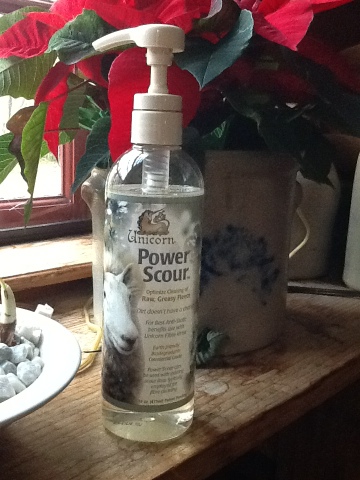
This weekend, I had a chance to try out a scouring product that I won as a door prize this past November at the "Gathering" (a Handspinner's conference, held biannually throughout the Northeast Handspinner's Guild)! I gave the mohair locks I had washed a couple of weeks ago another bath, since they were so very soiled. The product is called Power Scour, put out by Unicorn Products. I was pleasantly surprised. The mohair came cleaner, and I was able to use water from the tap...hot, of course. I usually use Orvus WA Paste, available from livestock or farm and garden establishments, generally used for washing sheep before showing them. Also a good product, but I like the fact that Power Scour can be used with a slightly lower temperature, and it is lightly scented, which I personally like.The mohair is ready for some sampling. Before I wash any more mohair from this particularly soiled fleece, I will attempt to remove more of the chaff and loose dirt and debris, by willowing it (beating it with sticks, for the uninitiated!). I found a Rambouillet cross fleece, in dark chocolate, in my cellar this morning. I confess, it is one of the casualties of my fleece stashing habit, which many handspinners are privy to! A lovely fine soft fleece.....I cleaned some of it with the Power Scour, and as you can see, it looks great! Smells nice, too! A couple of rinses and no agitation, yielded good success with both fleece samples.
Subscribe to:
Posts (Atom)